FAIR Signposting
MarineInfo implements FAIR Signposting to make metadata records easier to discover and navigate by machines. FAIR Signposting uses standard web links to explicitly connect related resources such as persistent identifiers, landing pages, machine-readable metadata, and downloadable content. These typed links allow automated agents to reliably find metadata, understand relationships between resources, and access them without manual interpretation, supporting the FAIR principles of findability, accessibility, and interoperability.
All resources have header link of structure <link rel="describedby" href="https://marineinfo.org/id/{type}/{id}" type="text/turtle">
For example:
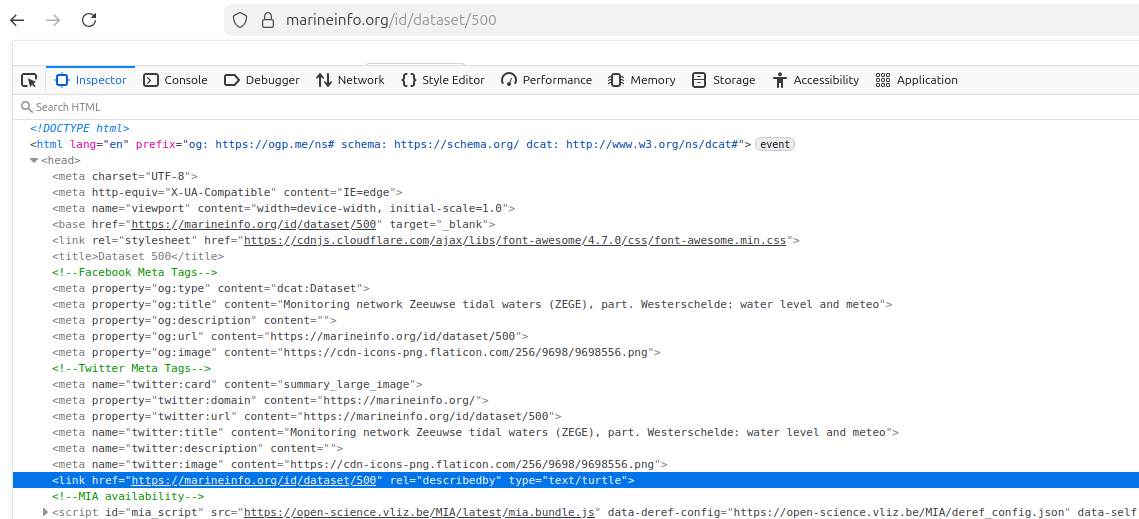
Additional information: https://zenodo.org/records/10490289, https://signposting.org/FAIR/
Search Engine & Scholarly Discovery
We want to ensure that our data is easily discoverable by search engines, scholarly indexes, and reference management tools through embedded, machine-readable metadata.
- Structured metadata (Schema.org / JSON-LD)
Publication pages automatically include Schema.org-compliant JSON-LD metadata embedded in the page header via<script type="application/ld+json">{record JSON-LD}</script>. This enables modern search engines to accurately interpret and index scholarly content. The current implementation focuses on publication records, aligning with Google’s indexing requirements, and is designed to be extensible to additional record types.
- Rich HTML metadata for sharing and citation
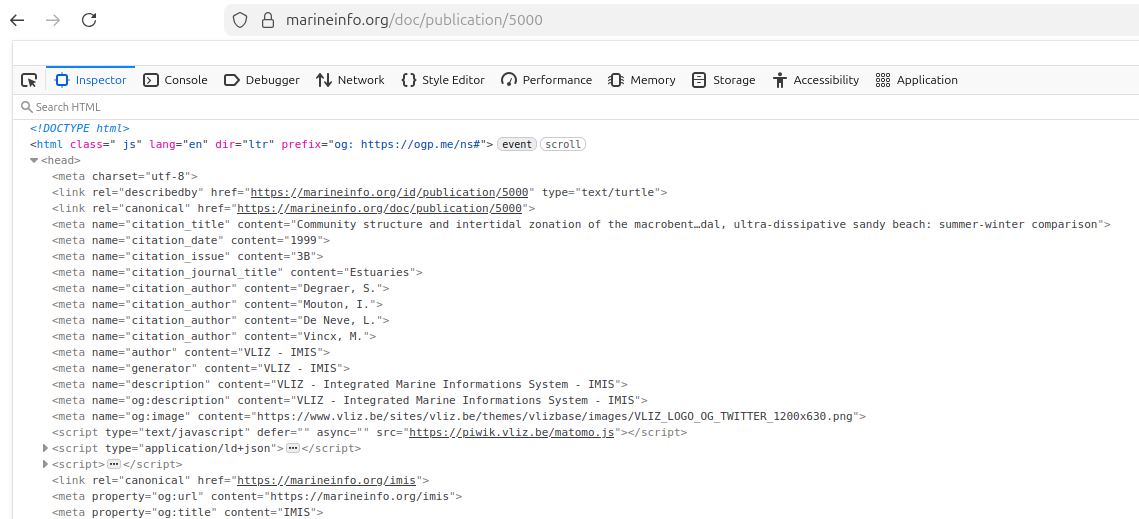
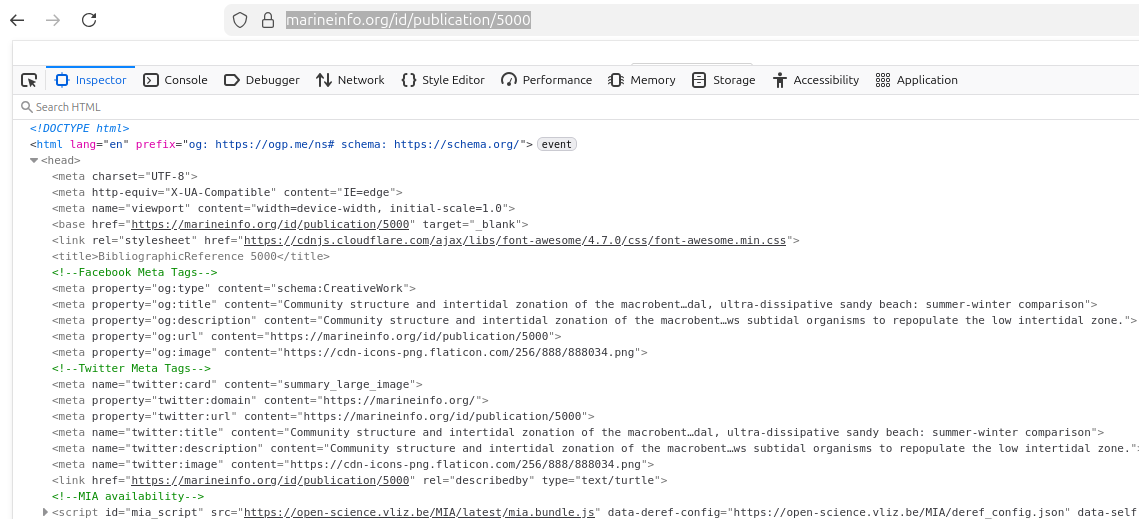
All resources include standard OpenGraph and Twitter meta tags, improving link previews and content reuse across social platforms and other services.
Publication records additionally expose scholarly meta tags that are recognized by Google Scholar and widely used reference managers such as Zotero, Mendeley, and EndNote, ensuring seamless citation and academic visibility.
LDES feed
MarineInfo provides an LDES-compliant feed per catalogue to expose recent changes in the IMIS system. These feeds enable third parties to efficiently stay synchronised with the latest additions and updates by consuming a standardised stream of change events. Each feed is published following the LDES specification and can be accessed via the following URI template:
https://marineinfo.org/feed/{type}
This approach supports automated, incremental harvesting of data and facilitates interoperability with external systems.
type
feed
dataset
https://marineinfo.org/id/dataset/feed
publication
https://marineinfo.org/id/publication/feed
institute
https://marineinfo.org/id/institute/feed
person
https://marineinfo.org/id/person/feed
project
https://marineinfo.org/id/project/feed
event
https://marineinfo.org/id/event/feed
OAI-PMH
We plan to implement an OAI-PMH harvesting service on MarineInfo to enable standardized metadata harvesting from our datasets.
MarineInfo-widget
We plan to make an MarineInfo widget available as a reusable component for integration into external websites and services.
Ontologies
To expose IMIS data, MarineInfo leverages a blend of several standard vocabularies alongside a limited set of self-defined terms and concepts. These additions enhance data integration and interoperability. They can be explored at:
DCAT descriptions
MarineInfo provides a DCAT-compliant description of the platform, exposing MarineInfo as a dcat:Catalog. This description provides structured access to all records and is available at:
By enabling discovery and integration of MarineInfo resources through standard DCAT mechanisms, this approach supports interoperability with external catalogues and data portals. Building on this, we plan to also provide DCAT-compliant descriptions of the MarineInfo service catalogue and the LDES feeds.